
Quick answer: 350 metres is not far — on paper. It’s a seven to ten minute walk, in the band where Makkah rooms commonly cost SAR 250–600 a night instead of SAR 400–1,000 closer in. But a young woman travelling with her parents, 60 and 58, was quoted an agency hotel about 350 metres away whose reviews frightened her — and her real problem wasn’t the metres. It was trust. If recent reviews report bedbugs, odour and roaches, no distance makes that room right. And paying for a second, closer room while your meals stay at the first hotel can leave you walking more, not less. Fix the base first: one hotel you trust, at a distance your parents can walk easily.
She’s 30, travelling with her father, who is 60, and her mother, who is 58. The travel agency’s hotel — full board — sits, she was told, around 350 metres from the Haram. Then she watched the YouTube videos and read the Google reviews: bedbugs, toilet odour, roaches. She was anxious, and said so plainly.
Her idea was to book a closer, better-known hotel as well. But it isn’t cheap, her meals would still be at the agency hotel — three walks back there a day — and the agency room would sit paid for and wasted. Her question: “Is booking a hotel room close to the Haram worth the money? What would you do, if you were in my position?”
Let’s take it in two halves — distance first, reviews second. The reviews are the real half.
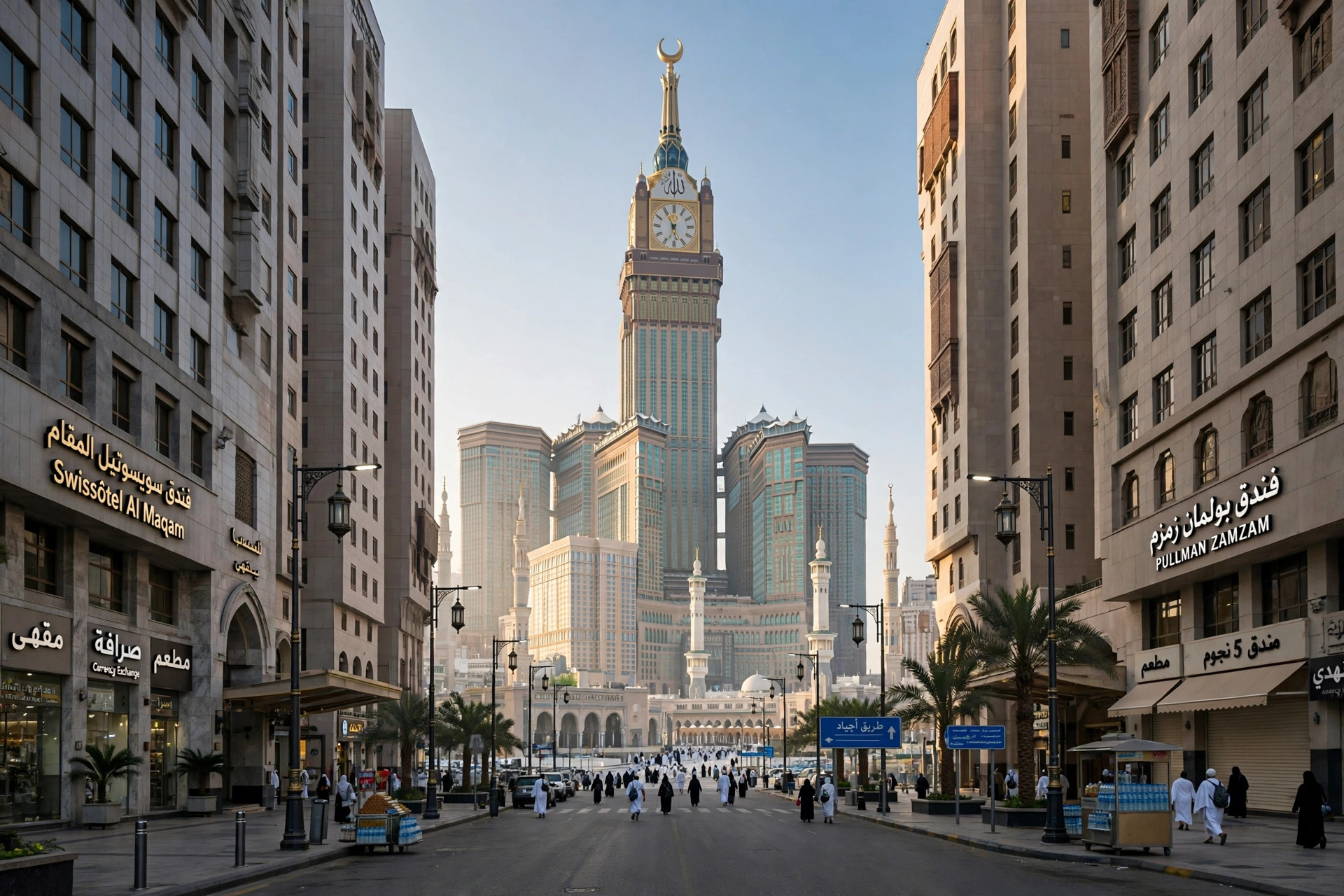
How far is 350 metres from the Haram, really?
Our hotels 300–500 metres from the Haram guide covers exactly this band: five hundred metres is about a seven to ten minute walk, and 350 metres sits at its nearer end. Plan on seven to twelve minutes from door to gate — and then the guide adds the part the map doesn’t tell you.
The walk back is often uphill. Much of this band sits on streets that rise away from the Haram — Ajyad Street slopes upwards as it runs away from the mosque, and parts of Ibrahim Khalil Road do the same. The walk to prayers is downhill and easy; the walk home, in the heat, with tired legs, is the one your parents will remember. At prayer times the streets fill and the pavements narrow, so leave ten minutes earlier than the distance suggests.
How much walking does 350 metres add up to in a day?
More than the number suggests. Seven to ten minutes each way, five times a day, is 70 to 100 minutes of walking a day — plus the walk inside the mosque. For a fit 30-year-old, that’s a pleasant rhythm. For her parents, in Makkah’s heat, it’s a real daily total, heavier as the trip goes on. The walk feels longer at Isha than at Fajr.
Now add her specific plan. Sleeping closer but eating at the agency hotel adds three walks a day to its dining room, on top of the prayers. A closer bed with a further table can mean more walking for her parents, not less.

What does staying closer actually cost — and save?
The saving at 350 metres is real. Rooms in the 300–500 metre band commonly cost around SAR 250 to SAR 600 a night outside peak season; the 100–300 metre band runs around SAR 400 to SAR 1,000. Over ten nights, her band is often SAR 2,000 to SAR 5,000 cheaper for a similar room — for a family booking two rooms, a saving that can pay for the whole trip’s food.
Closer still, prices climb steeply. The 0–100 metre band has no budget hotels at all; the land closest to the Haram is the most expensive in the city. So “just stay closer” is never a small decision — it moves a large sum from nights, food or comfort elsewhere into metres.
When is paying more to stay closer worth it?
When the walk itself is the obstacle. Our distance guide is blunt about who should avoid the 300–500 metre band: anyone who struggles to walk, has a bad knee or a heart condition, or uses a wheelchair. Ten minutes each way, five times a day, uphill on the way back, is too much for many elderly pilgrims — and once you’re booked, there’s no way to shorten it. For a family in that position, the closer hotel isn’t a luxury. It’s the difference between praying in the Haram and praying in the hotel.
Her parents are 60 and 58, and she doesn’t describe them as unable to walk. If they’re reasonably fit, 350 metres on its own is manageable — thousands of pilgrims their age walk it daily. Which brings us to the half of her question the metres can’t answer.
What if the problem isn’t the distance, but the hotel itself?
Then no. A room you’re afraid to sleep in isn’t made right by being near, or by being cheap. Bedbugs, odour and roaches in recent reviews aren’t complaints about decor — they’re complaints about the one thing a hotel owes your parents: rest. Every guide on this site gives the same advice: read recent reviews about cleanliness and the lift, not the hotel’s own description. She did exactly that. She should trust what she found.
But notice what follows. If the agency hotel can’t be trusted for sleep, it can’t be trusted for food either — yet her plan keeps her parents eating there three times a day while paying twice for beds. The two-hotel fix treats the symptom and keeps the cause. The cleaner question for the agency is simpler: can the base hotel be changed? One trusted hotel, at a distance her parents can walk — even at the same 350 metres — and she may not need the closer room at all.

What should you check before paying more to move closer?
Four questions, borrowed from our distance guide, for any hotel — the one you have, or the one you’re eyeing. First, which gate? A hotel 400 metres from one gate can be 800 metres from the next. Second, is the walk back uphill, and how steep? If the hotel calls a slope flat, ask again. Third, is there a shuttle, where does it drop you, and does it run at Fajr? Fourth, what’s on the street — a crossing, lighting, life after Isha?
Add one of your own: ask whether the lift can handle prayer-time crowds, because a fine room above a broken lift is a daily climb. Our guide for elderly and wheelchair pilgrims in Makkah covers the rest, including wheelchairs, before you travel.
What would a calm answer to her question look like?
Something like this. Don’t pay for two hotels: the double payment buys a closer bed, keeps a distrusted dining room, and your parents walk more, not less. Take the reviews seriously, and put the energy into changing the one booking you have — a cleaner hotel, at 350 metres or closer if the price allows, with your meals where you sleep.
And if the closer room does win, let it win for the right reason — not because 350 metres is far, but because your parents’ rest is what the trip is built on. Metres can be walked. Lost sleep can’t be recovered.
Frequently asked questions
Is 350 metres too far to walk to the Haram?
For a fit adult, no — it’s about a seven to ten minute walk. For an elderly pilgrim, or anyone with a bad knee, it can be too far, especially uphill on the way back. Five prayers a day at that distance adds up to 70 to 100 minutes of walking daily.
How much do you save by staying 300–500 metres away?
As a rough guide, rooms in this band commonly cost around SAR 250 to SAR 600 a night outside peak season, against around SAR 400 to SAR 1,000 in the 100–300 metre band. Over ten nights the saving is often SAR 2,000 to SAR 5,000. Always check the price for your own dates.
Should bad reviews make me change an agency hotel?
Reviews about cleanliness — pests, odour, bathrooms — are worth acting on, because rest is what the room is for. Read recent reviews rather than old ones, and raise what you find with the agency before you travel. Changing one booking is almost always better than paying for a second hotel while keeping the first.
Is it worth booking a second, closer hotel while keeping the first?
Rarely. If your meals stay at the first hotel, you add three walks a day to its dining room on top of the prayers, and the first room is paid for and wasted. One trusted hotel, at a distance your group can walk with ease, serves elderly parents better than two hotels split between sleeping and eating.
If you’re making this decision for your own parents, our 300–500 metre guide and the hotel guides for every other band will help you see the walk clearly, and the expenses guides show what the saving at each distance could pay for instead.