
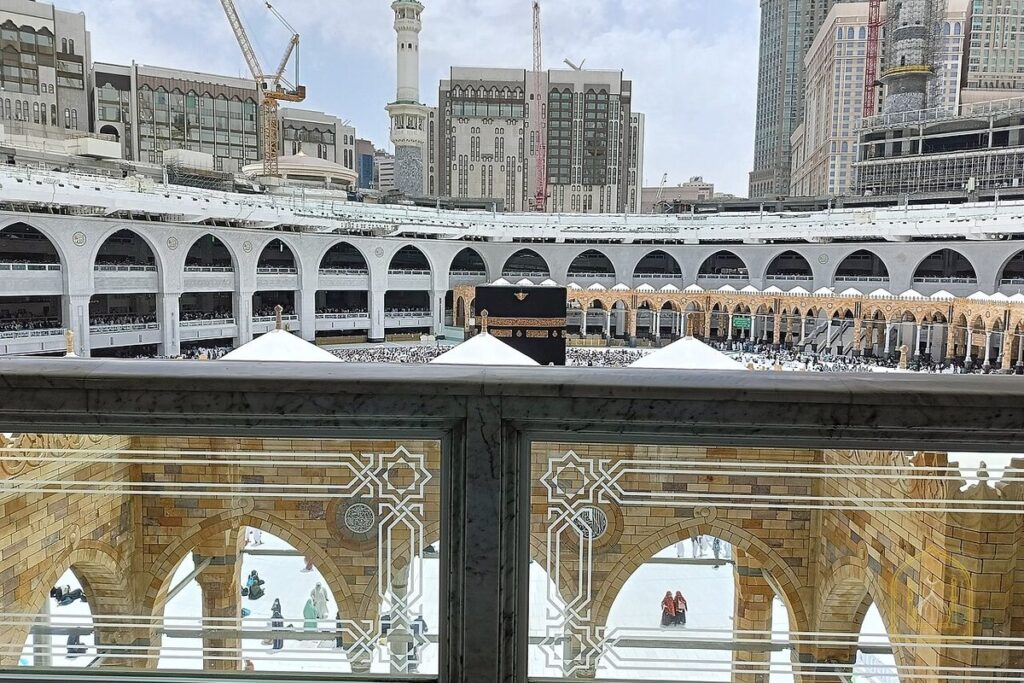
For an elderly pilgrim, or one who uses a wheelchair, the right hotel in Makkah is not the cheapest or the grandest — it is the one that makes the journey to the Haram short, flat and step-free. A hotel 300 metres away on flat ground can be far easier than a hotel 100 metres away at the top of a slope. This guide covers the step-free gates, the wheelchair help inside the Haram, and exactly what to ask a hotel before you book.
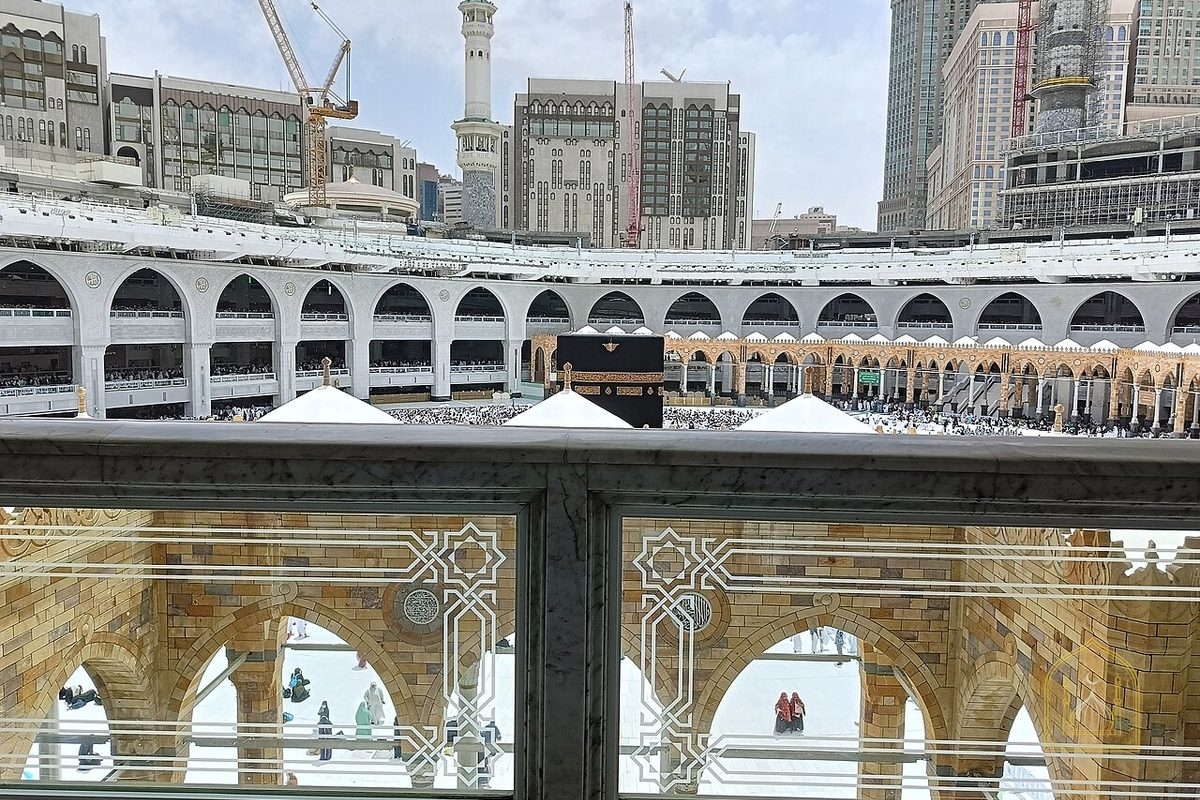
Which gates of the Haram are step-free?
The General Authority for the Affairs of the Grand Mosque and the Prophet’s Mosque has equipped a number of gates with ramps for wheelchair entry and exit. Guides reporting the Authority’s announcements list gates 68, 74, 79, 84, 89, 90, 93 and 94 among those with ramps, and accessible restrooms are reported at gates including 11, 68, 74, 79, 89, 90, 93 and 94.
Gate numbers and open/closed status change routinely — gates are closed or re-routed during Ramadan, Hajj and busy weekends — so never treat any list as a live map. Confirm the open, step-free entrance with mosque staff or your hotel on the day you visit. As a rule, pick one gate and use it every time: it becomes your meeting point, and your family always knows where to find you. King Fahd Gate (Gate 79) has large escalators and lifts, and King Abdulaziz Gate (Gate 1), by the Clock Tower, leads straight to the Mataf.
How do free wheelchairs in the Haram work?
Manual wheelchairs are lent free of charge, 24 hours a day, by the Grand Mosque authority at set points in Masjid al-Haram. The two main free wheelchair points reported are the eastern courtyard near Gate 19 (Bab al-Salam) and the western courtyard at the Shubaika Bridge (Gate 64). Other collection points are reported near gates 306, 309, 343, 369 and 330.
The free chairs come without someone to push them, so a family member needs to do the pushing. If you need a pusher, paid manual wheelchairs with an attendant are available at counters on the Mas’a, the Mataf and the courtyards. A free safety wristband is also available for elderly and disabled visitors — it carries the pilgrim’s name and a relative’s phone number so staff can reunite them with their family if they get separated. Wristbands are handed out at five points, including King Abdulaziz Gate, King Fahd Gate and Ismail Gate.
If you bring your own wheelchair, note that older guides report you may need a permit from the office near Gate 12, and that a personal wheelchair is directed to the first floor or above rather than the ground-floor Mataf. Check this on arrival, as the rules change.
What about electric carts for tawaf and sa’i?
Electric carts — small golf-cart style vehicles — run on the roof level for tawaf and sa’i, and they are the best option for a pilgrim who cannot walk the full circuit. Carts can be booked through the Tanaqol app or the Unified Mobility Platform, with pickup and drop-off at designated gates reported as Al-Marwah (25), Al-Arqam (16), Ajyad (5) and Al-Shubaika (66). Booking is by date and time with electronic payment.
Two different cart services run in the mosque, and their prices are different, so do not mix them up. Shared golf carts, bought on the day at the gates, are reported at SR 50 per person. Separately, carts booked ahead through the Tanaqol app are reported at SAR 300 per person for a full Umrah, with a 50% discount reported for pilgrims over 65 and free use reported for people with verified disabilities — a disability certificate or ID with a passport is needed for the discount or free service. Self-drive electric scooters are a third option, reported at SAR 57.50 for tawaf or sa’i alone and SAR 115 for both on a single-seater. Treat all of these prices as reported figures and confirm them in the Tanaqol app before you travel, as they change. There are also designated prayer areas for people with disabilities inside the mosque — reported as six for men and six for women. For men, the areas near Door 68 and opposite Door 91 are named; for women, Door 65 and Door 88.
What should you ask the hotel before booking?
Ask these questions in writing — by email or message — and keep the reply. Do not rely on a booking site’s tick boxes, which are often wrong.
- Is the entrance step-free? Can a wheelchair roll from the street into the lobby without steps? Is there a ramp, and is it actually open, not blocked by luggage trolleys?
- Is there a lift to every floor, and does it fit a wheelchair? Ask for the lift’s size. Some older hotels have small lifts a standard wheelchair cannot enter.
- Is there a wheelchair-friendly room? Ask for a wide door, space to turn a chair beside the bed, and a bathroom with grab rails, a walk-in shower and a raised toilet seat.
- How far is it to the nearest step-free gate, in metres, and is the route flat? Ask for the gate number, not “five minutes”. A hotel on a slope in Ajyad can be harder than a flatter hotel further away.
- Does the shuttle take wheelchairs? If the hotel is in a shuttle zone, ask whether the bus has a ramp, how often it runs, and where it drops you.
- Can the hotel lend or hire a wheelchair? Some hotels keep chairs for guests; others do not.
If the hotel cannot answer these questions clearly, that is your answer: book somewhere else.

Which areas keep the walk flat and short?
Distance matters, but flatness matters more. The closest bands are the best starting point: our hotels 0–100 metres from the Haram and our hotels 100–300 metres from the Haram put you steps from a gate, usually on flat ground around the mosque courtyard. The Abraj Al Bait complex, directly opposite King Abdulaziz Gate, is flat and has indoor walkways — but it is also the most expensive area in the city, so check the prices in our budget guide before you commit.
Ajyad is close but hilly in parts: the streets rising away from the Haram are steep, and a hotel that looks near on the map can mean a hard push uphill. Misfalah, on the western side near King Fahd Gate, is flatter and often cheaper, and the walk to Gate 79 is level for much of the way. Ibrahim Khalil Road is mostly flat too, though the walk is longer. Avoid hotels that require a steep street, a pedestrian bridge or a long underpass — and be careful with shuttle-zone hotels in Aziziyah, where the drop-off point may still leave a long walk and boarding a crowded bus with a wheelchair at prayer time is difficult.
How do you plan the day so an elderly pilgrim is not exhausted?
Pray in the Haram for Fajr and Isha, when it is cooler, and rest in the hotel during the heat of the day — Makkah is punishing at midday, and an elderly pilgrim does not need to be out in it. Use the electric cart for tawaf and sa’i rather than walking the full circuit. Take water, and rest in the shaded courtyards between prayers rather than walking back and forth to the hotel.
Ask the hotel for a room on a low floor near the lift, and for a shower chair and a non-slip mat if the bathroom has no rails. Keep the hotel’s number and the room number on a card in the pilgrim’s pocket, with a family member’s number. Do Umrah late at night or after Fajr, and build in a rest day after two or three days of full prayers.
For medicines, clinics and staying well, see our Health guide.
Frequently asked questions
Are wheelchairs free inside Masjid al-Haram?
Yes. The Grand Mosque authority lends manual wheelchairs free of charge, 24 hours a day, at set points — the main ones are the eastern courtyard near Gate 19 (Bab al-Salam) and the western courtyard at the Shubaika Bridge (Gate 64). The free chairs come without a pusher.
Which gates have ramps for wheelchairs?
Gates 68, 74, 79, 84, 89, 90, 93 and 94 are reported to have ramps, but gate status changes often. Confirm the open step-free entrance with mosque staff or your hotel on the day.
How much does an electric cart cost for tawaf?
Shared golf carts bought on the day are reported at SR 50 per person. Carts booked ahead through the Tanaqol app are reported at SAR 300 per person for a full Umrah, with 50% off reported for pilgrims over 65 and free use reported for people with verified disabilities. Self-drive scooters are reported at SAR 57.50 for tawaf or sa’i alone and SAR 115 for both. Confirm the price in the app before you travel.
What should I ask the hotel before booking?
Whether the entrance is step-free, whether the lift fits a wheelchair, whether there is a wheelchair-friendly room with grab rails, the distance in metres to the nearest step-free gate, and whether the shuttle takes wheelchairs. Get the answers in writing.