
Mina is the valley of white tents where pilgrims stay during the days of Hajj, and where they perform the stoning of the Jamarat — throwing pebbles at three stone pillars. It is known as the “City of the Tents”, and during Hajj it becomes one of the largest tent cities in the world. This guide explains what Mina is, where it is, how pilgrims visit it, and what to know before you go.
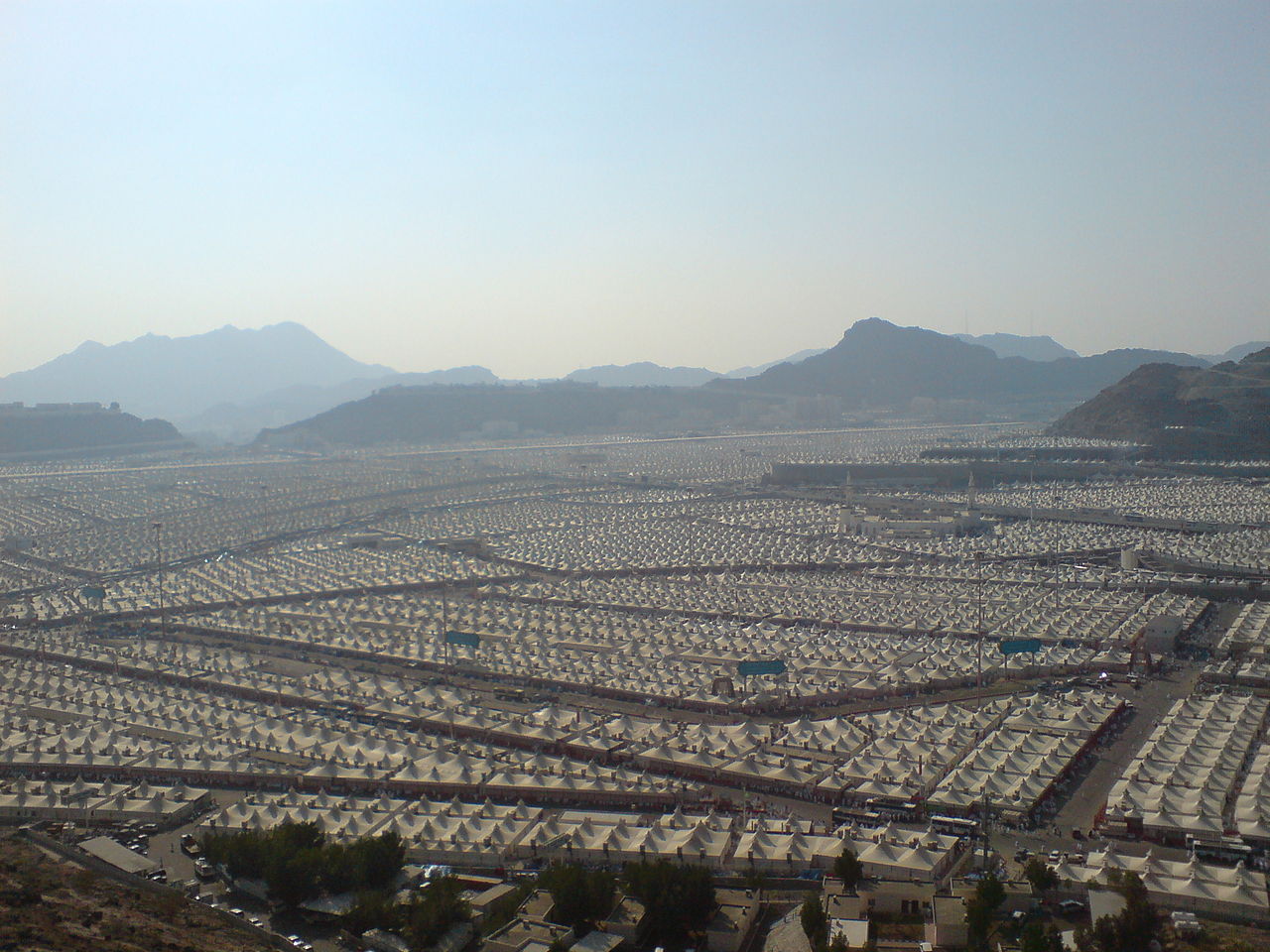
Mina, the valley of tents, south-east of Makkah. Photo: Wikimedia Commons.
What is Mina, and why is it important?
Mina is a valley south-east of Makkah where pilgrims stay on the days of Tashreeq — the 11th, 12th and (for those who stay) 13th of Dhul-Hijjah — during Hajj. It is also where the stoning of the Jamarat takes place: pilgrims throw seven pebbles at each of three pillars, remembering the Prophet Ibrahim’s rejection of Shaytan. The pillars stand at the end of the valley, under the Jamarat Bridge, a large multi-level structure built to let pilgrims stone safely.
The valley is filled with row upon row of white, fire-resistant tents, which is why Mina is called the “City of the Tents”. Outside Hajj the tents stand empty and the valley is quiet.

The white tents of Mina. Photo: Wikimedia Commons.
Where is Mina?
Mina lies south-east of Makkah, between the city and Muzdalifah, on the road towards Arafat. From the Haram it is a drive out through the south-east of the city. The valley is long and narrow, and the tents fill it from end to end. The Jamarat Bridge stands at the western end of the valley, nearest Makkah.
How do pilgrims visit Mina today?
Outside Hajj, Mina is quiet and largely empty, and a ziyarat visit means driving through the valley to see the tents and the Jamarat Bridge from the road. You cannot enter the tents, which are reserved for Hajj pilgrims, and the Jamarat area itself is a Hajj facility — you view it from outside.
During Hajj, Mina is where pilgrims live. They arrive from Muzdalifah on the morning of the 10th of Dhul-Hijjah, stone the largest pillar (Jamrat al-Aqabah), and then stay in the tents for the days of Tashreeq, going out each day to stone all three pillars. Your Hajj group arranges your tent and your transport; you do not need to arrange it yourself.
What is the stoning of the Jamarat?
The stoning (ramy) is the rite of throwing pebbles at three pillars in Mina. On the 10th of Dhul-Hijjah, pilgrims stone only the largest pillar, Jamrat al-Aqabah, with seven pebbles. On each of the days of Tashreeq, they stone all three pillars — the smallest, the middle and the largest — with seven pebbles each. The pebbles are collected at Muzdalifah the night before.
The rite remembers the Prophet Ibrahim, who — as tradition tells — threw stones at Shaytan when he tried to turn him from Allah’s command. It is a rite of Hajj only; it is not performed outside Hajj.

Pilgrims arriving in Mina. Photo: Wikimedia Commons.
What are the practical tips for visiting Mina?
- Visit outside Hajj if you want to see the valley; during Hajj it is closed to anyone who is not a pilgrim.
- The valley is very large and the tents look alike — if you come on a ziyarat tour, your driver will know where to stop.
- There is little shade in the valley, so bring water and sun protection.
- Do not try to enter the tents or the Jamarat Bridge area outside Hajj; they are closed.
- During Hajj, follow your group’s plan and keep your group’s contact details with you.
- Keep the valley clean and respect the pilgrims who are staying there.
From Mina the pilgrims return to Makkah for the farewell Tawaf. See our Muzdalifah guide and our Arafat & Jabal al-Rahmah guide.
Mina is a key Hajj site — see our Hajj guide for the full picture.